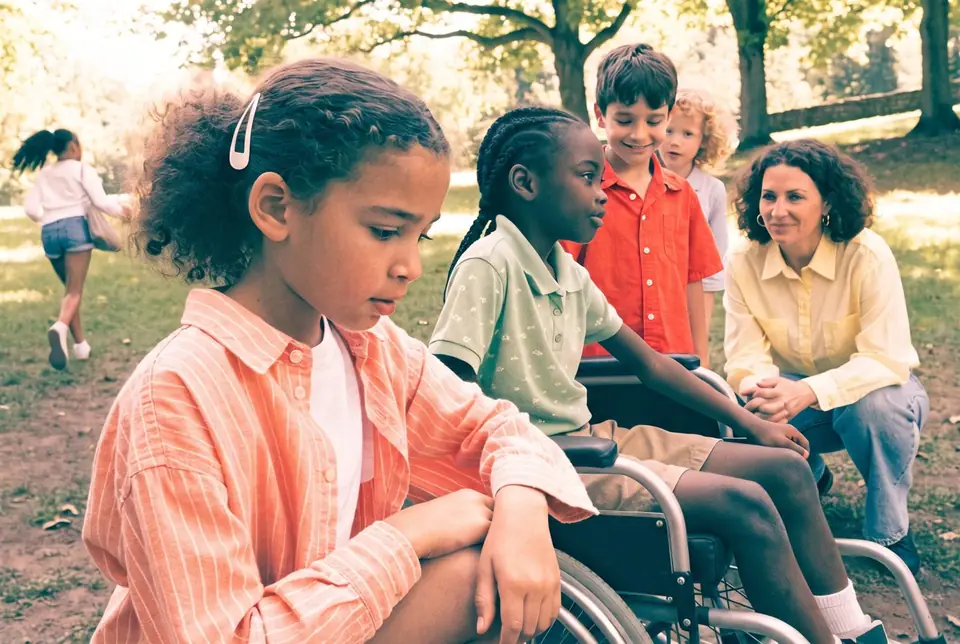
Children and an adult sit together outside, including a child using a wheelchair.

Four Beyonds

Beyond the Classroom

Inclusion is the whole school day, not only core academics.

Specials, lunch, recess, field trips, assemblies, clubs, athletics, transitions, sensory access, and peer belonging.

When those spaces are an afterthought, children tell us with their behavior, or with their absence.

  • Environment maps for the hidden curriculum
  • Participation plans for specials and recess
  • Transitions designed to reduce load

Who it is for

Adults responsible for the parts of school that are not a lesson.

This page is for families who watch the day fall apart at lunch, recess, specials, or the bus line. It is for teachers, paras, and related-service providers who do not control the bell schedule. It is for school teams who wrote a strong classroom plan and never walked it to the cafeteria.

We do not need a child’s name or a photo of a hard moment. Describe the space. Arrival, art, the hallway, the field trip. Leave the identifying details out of the first note.

What a working conversation looks like

We walk the day with the adults who run it. We mark where access, participation, or belonging drops. We turn the written supports into something those adults can try tomorrow, in that space, with the staff they actually have.

That is consultation. We do not decide placement. We do not add a new program to your campus, and we do not publish a fee. A school-wide version of this work is named on For Schools. A family can start on the contact form.

The supports for those spaces have to be written somewhere the team will see. That writing lives in Beyond the Paperwork.

For a family's view of the same day, read Inclusion Doesn't End at the Classroom Door.

Plain language

The day outside the lesson is still school.

The rules below are federal. They are not a placement order for any one child. Your team makes that call. An advocate can help you if you need one. We will not make it from a web page.

Least restrictive environment

To the maximum extent appropriate, children with disabilities are educated with children who are nondisabled. Separate classes or separate schooling happen only if the nature or severity of the disability means education in regular classes, with supplementary aids and services, cannot be achieved satisfactorily. “Appropriate” is doing a lot of work in that sentence. It is not a slogan, and it is not a promise of one classroom. 34 CFR § 300.114.

Meals, recess, and the rest

When a school provides nonacademic and extracurricular activities, the rule names meals and recess periods. Each child with a disability participates with nondisabled children in those activities to the maximum extent appropriate to that child’s needs. The school must also provide the supplementary aids and services the IEP team decided are appropriate and necessary for those settings. 34 CFR § 300.117.

It belongs in the IEP

An IEP has to describe the services and supports that let the child be involved in the general curriculum and participate in extracurricular and other nonacademic activities. If the child will not participate with nondisabled children in the regular class or in those activities, the IEP has to explain the extent of that. A verbal promise in the hallway is not that explanation. 34 CFR § 300.320.

Tomorrow

Questions to take to your own team

Ask these at the next meeting, or in the five minutes you have with a colleague before recess. They are questions, not a finding that the school has failed.

  • Which parts of the day are missing from the plan: arrival, specials, lunch, recess, clubs, the field trip, dismissal?
  • What supplementary aids and services did the IEP team name for nonacademic settings, and who in that room has them?
  • What happens in the transition between classes, and what can we change tomorrow so the load is lower?
  • If the child is absent from those spaces, or behavior is the only signal, what is the space asking of them? Behavior as information is Beyond the Behavior.

Education and consultation, not legal advice, and not a substitute for clinical care. The regulation links are the Cornell Legal Information Institute’s reprint of the Code of Federal Regulations.